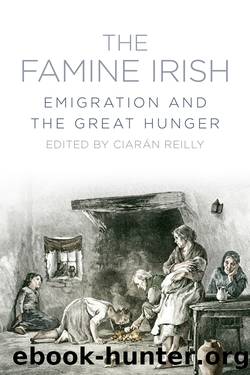
The Famine Irish by Ciaran Reilly
Author:Ciaran Reilly [Reilly, Ciarán]
Language: eng
Format: epub
ISBN: 9780750968805
Publisher: The History Press
Published: 2016-03-07T00:00:00+00:00
7
The women of Ballykilcline, County Roscommon: Claiming new ground
Mary Lee Dunn
Slieve Bawn, your ghosts are reticent;
They haunt shy corners of the past.
If we want them to speak to us
Truthfully, they have to be asked.1
If historian Robert Scally wrote little about the women of Ballykilcline in County Roscommon in his 1996 book The End of Hidden Ireland, it was likely due to their near invisibility in Famine-era records, his primary sources.2 Scally could not draw on archaeology either since such excavations in the townland were only just beginning, carried out by Charles E. Orser and others.3 However, the women of Ballykilcline are present in the Crownâs list of evictees as it administered its emigration scheme for the hundreds of residents of the troubled neighbourhood in 1847 and 1848. Here we find the tenantsâ names, ages, and their contexts in nuclear families. The survival of this list meant that it was possible to trace these immigrants in the USA. Indeed, only two years after their arrival in New York, in 1850, the federal census began recording data on all individuals rather than just naming the heads of families and the age groupings and gender of wives, children, and others as had been the custom in the past. Moreover, journalism and other public record-keeping were evolving so that the sources that named individuals â such as court and police records, newspaper accounts, school and church data â multiplied to the extent that we can begin to characterise the immigrants and trace their lives with greater detail and confidence. Fortunately, in the case of Ballykilcline, which was part of the civil parish of Kilglass, we can also access troves of family records due to the organisation in 1998 of the Ballykilcline Society, which is devoted to the descendantsâ family history, genealogy and local history.4 Thus, increasingly, a picture of these emigrants becomes clearer. This chapter examines the women of Ballykilcline, their work, family and social lives over several generations. It also draws on more recent research than was available to Scally and the knowledge gathered by their descendants to help characterise them. And so we ask questions of the new sources and new data; as poet Kieran Furey suggested above, to know more, âthey have to be askedâ.5
Ballykilcline is located near the River Shannon where counties Leitrim, Longford, and Roscommon come together near Rooskey, a few miles north-east of Strokestown. In 1690, during the âWar of the Two Kingsâ, in which William of Orange defeated James II, Ballykilcline was seized by Crown forces. A century later in 1793, the land was leased to the Mahon family of Strokestown (barons Hartland after 1800), whose estates amounted to just over 11,000 acres. The Mahonsâ lease on Ballykilcline ended in 1834 when they declined to renew it and the townland again reverted to the Crown. This development initiated a rent strike which continued until 1848 when the Crown evicted the inhabitants, paying for their passage to New York City in an effort to rid the area of the trouble they had incited.
Download
This site does not store any files on its server. We only index and link to content provided by other sites. Please contact the content providers to delete copyright contents if any and email us, we'll remove relevant links or contents immediately.
| Africa | Americas |
| Arctic & Antarctica | Asia |
| Australia & Oceania | Europe |
| Middle East | Russia |
| United States | World |
| Ancient Civilizations | Military |
| Historical Study & Educational Resources |
Room 212 by Kate Stewart(5185)
The Crown by Robert Lacey(4868)
Endurance: Shackleton's Incredible Voyage by Alfred Lansing(4847)
The Iron Duke by The Iron Duke(4409)
The Rape of Nanking by Iris Chang(4265)
Joan of Arc by Mary Gordon(4159)
Say Nothing by Patrick Radden Keefe(4048)
Killing England by Bill O'Reilly(4043)
I'll Give You the Sun by Jandy Nelson(3498)
Shadow of Night by Deborah Harkness(3412)
Hitler's Monsters by Eric Kurlander(3388)
Blood and Sand by Alex Von Tunzelmann(3242)
Mary, Queen of Scots, and the Murder of Lord Darnley by Alison Weir(3241)
Eleanor & Park by Rainbow Rowell(3239)
Darkest Hour by Anthony McCarten(3162)
Margaret Thatcher: The Autobiography by Thatcher Margaret(3113)
Book of Life by Deborah Harkness(2986)
Red Famine: Stalin's War on Ukraine by Anne Applebaum(2972)
The One Memory of Flora Banks by Emily Barr(2900)
